


Meta description: Discover how to choose safe, enriching dog toys for puppies, adult dogs, power chewers and seniors, with helpful tips from All Creatures, Crates & All.
A spacious garden, nutritious food and plenty of daily walks all matter to your dog’s wellbeing. But one small detail can make a surprisingly big difference to their happiness: choosing the right dog toys.
The best toy is not always the biggest, toughest or most colourful one. It is the toy that suits your dog’s age, size, chewing strength and personality while giving them a safe way to play, explore and spend time with you.
At All Creatures, Crates & All, we believe those little moments of play are meaningful acts of care. Here is our practical guide to choosing dog toys that support both fun and enrichment.
🐾 Why dog toys are important
Dog toys provide more than entertainment. They can help your pet express natural behaviours such as chewing, carrying, chasing, tugging and investigating.
A suitable selection of dog toys may help to:
- Provide mental stimulation when your dog is home alone
- Reduce boredom and unwanted chewing
- Support positive interaction between you and your pet
- Encourage movement and active play
- Offer comfort and familiarity
- Make training sessions more engaging
Every dog is different. One may happily retrieve a toy for half an hour, while another would rather settle down with a soft toy or work out how to reach a hidden treat.
The key is to offer variety without overwhelming your dog. A small rotation of toys can keep playtime interesting while allowing you to notice which activities your pet enjoys most.
🎾 Types of dog toys and their benefits
🧸 Plush dog toys: comfort and gentle play
Soft toys can be enjoyable for dogs who like carrying, cuddling or gently shaking their toys. They are often a lovely choice for puppies, calm adult dogs and pets who enjoy having a familiar comfort object.
However, plush toys are not suitable for every dog. If your pet quickly removes stuffing, eyes or labels, supervise play closely and replace the toy as soon as it becomes damaged.
Best for:
- Gentle chewers
- Carrying and comfort
- Quiet indoor play
- Dogs who enjoy soft textures
🔊 Squeaky dog toys: stimulating interactive play
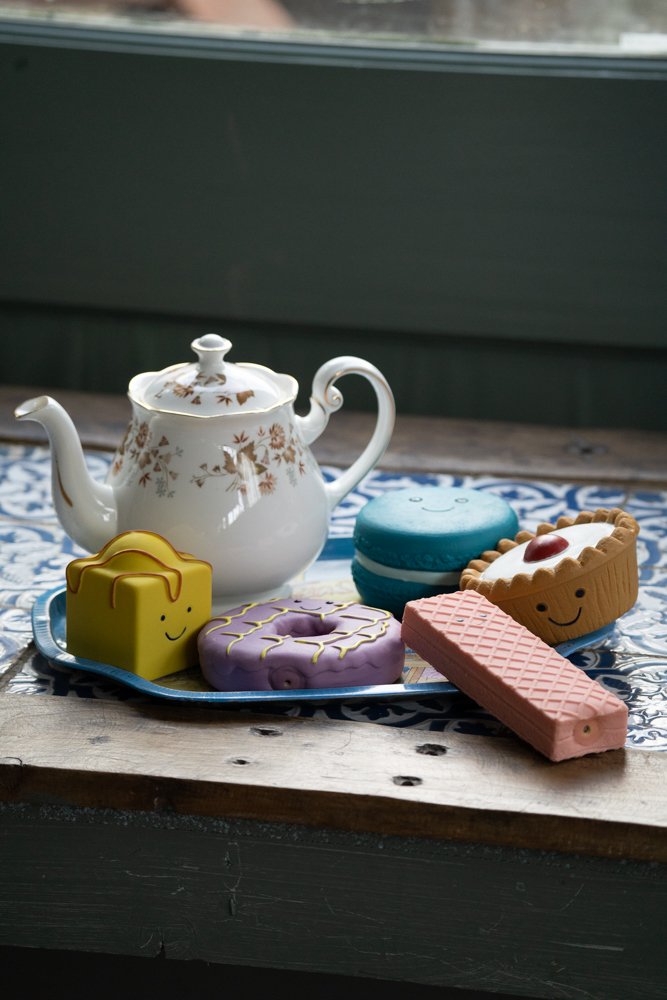
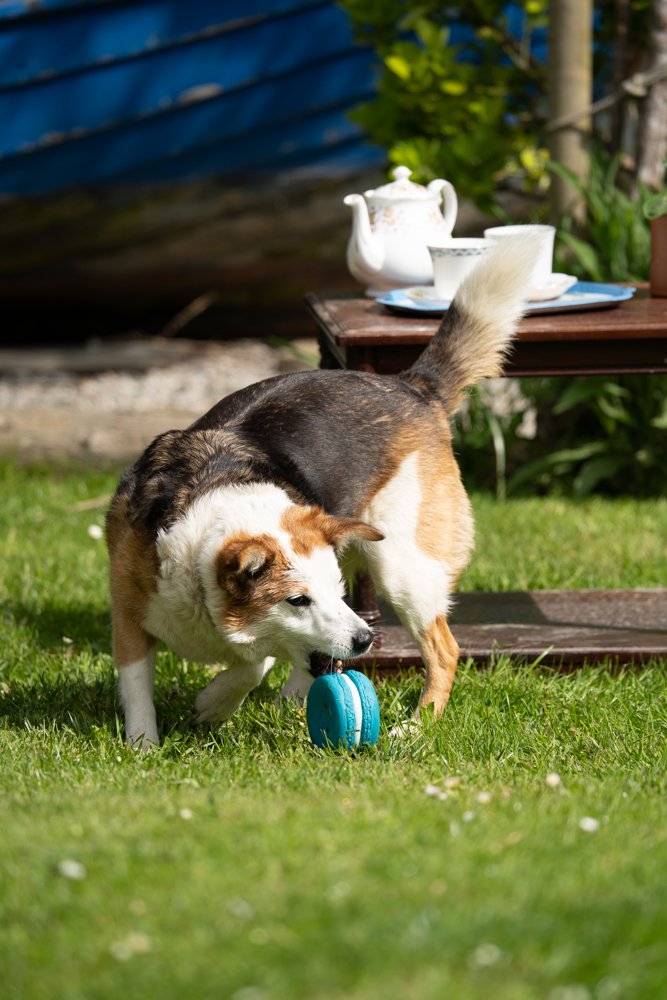
Squeaky toys can encourage dogs to chase, investigate and engage with you. Our playful Afternoon Tea Toys include fun designs such as the Cherry Bakewell, Fondant Fancy, Macaron, Iced Ring and Pink Wafer.
The Cherry Bakewell Latex Dog Toy has a built-in squeaker and is described as suitable for interactive play and training. It is supplied as one toy, making it a cheerful addition to a wider toy rotation.
Pros:
- Encourages interaction
- Adds sound and sensory interest
- Useful for short training games
- Fun for dogs who enjoy carrying and retrieving
Things to remember:
- Supervise your dog when introducing a squeaky toy
- Remove the toy if the squeaker or pieces become exposed
- Do not assume that “durable” means indestructible
🦷 Chew toys: satisfying natural behaviour
Chewing is a normal behaviour, especially for puppies and energetic young dogs. Suitable chew toys can give your pet an appropriate outlet while helping to protect household furniture from curious teeth.
Choose chews that are the right size and appropriate for your dog’s chewing style. A toy that is extremely hard may be unsuitable for some dogs, particularly those with dental problems or fragile teeth.
Our Antler Dog Chews are listed as suitable for dogs over eight months old. The product guidance also recommends disposing of the antler once it has worn down to a size your dog could fit in their mouth or swallow.
Because every dog’s teeth and chewing habits are different, we recommend discussing hard chews with your vet if you have any concerns. Always supervise chewing and inspect the chew regularly.
🪢 Tug and fetch toys: active bonding
Fetch and tug games are excellent ways to combine physical activity with time together. They can be especially enjoyable for dogs who love to run, carry objects or work alongside their owner.
For fetch toys, choose a size that your dog can comfortably carry without being able to swallow it. Avoid damaged balls, loose parts and toys that could become lodged in your dog’s mouth.
For tug toys, teach your dog to release the toy calmly. Keep sessions positive and stop if your dog becomes over-excited or begins to chew through the material.
🐶 How to choose dog toys for different dogs
| Your dog | Suitable dog toy ideas | What to consider |
|---|---|---|
| Puppy | Soft rubber chews, gentle plush toys and simple interactive toys | Choose puppy-appropriate sizes and supervise closely while they learn what is safe to chew. |
| Gentle adult dog | Plush toys, squeaky toys, fetch toys and lighter chews | Offer a mixture of comfort, movement and interactive play. |
| Power chewer | Robust toys designed for chewing and supervised tug toys | Check for damage frequently. No dog toy is completely indestructible. |
| Senior dog | Softer toys, gentle comforters and easy-to-carry toys | Avoid toys that are too heavy or hard, particularly if your dog has dental or mobility concerns. |
| Anxious or easily frustrated dog | Comfort toys and simple enrichment activities | Start with easy games where your dog can succeed quickly. Keep play calm and encouraging. |
Your dog’s breed can offer clues, but their individual personality matters just as much. A retriever may enjoy carrying and fetching, while a terrier may prefer chasing, shaking and investigating.
✅ Dog toy safety: our essential checklist
Before giving your dog a new toy, take a moment to check the following:
1. Choose the correct size
A toy should be large enough that your dog cannot swallow it whole. Balls and small toys can be particularly risky if they are too small for your pet’s mouth.
2. Check the materials
Look for toys made specifically for dogs and avoid anything with loose strings, ribbons, detachable parts, batteries or sharp edges.
3. Apply the thumbnail test
If a chew is so hard that you cannot make a small mark with your thumbnail, it may be too hard for your dog’s teeth. When in doubt, ask your vet for advice.
4. Supervise at first
Watch how your dog uses a new toy. Some pets carry and gently mouth toys, while others immediately try to shred them. That difference should guide how and when the toy is used.
5. Inspect toys regularly
Look for:
- Tears or cracks
- Loose stitching
- Exposed stuffing
- Missing squeakers
- Splintering or sharp edges
- Pieces that could be swallowed
Discard damaged toys promptly. It is far better to replace a favourite toy than risk an emergency.
6. Keep toys clean
Wash toys according to the manufacturer’s instructions and allow them to dry fully. If a toy continues to smell unpleasant after cleaning, it may be time to replace it.
For additional UK guidance, the PDSA’s advice on choosing a safe ball for your dog and Blue Cross guidance on puppy and dog toys are useful resources.
🧺 Create a simple toy rotation
You do not need to leave every toy available all the time. Keeping a few toys out and storing the rest can help each one feel more interesting when it reappears.
Try this simple routine:
- Keep three or four toys available
- Include different types, such as a soft toy, squeaky toy and chew
- Swap one or two toys every few days
- Wash toys during the rotation
- Remove anything damaged before returning it to playtime
You can also pair play with everyday training. Ask your dog to wait, find, fetch or release the toy, rewarding calm and thoughtful behaviour along the way.
🛍️ Our dog toy essentials
If you are building a new toy collection, start with a small, balanced selection rather than buying everything at once.
We recommend considering:
- One interactive toy for playing together
- One comfort or plush toy for calmer moments
- One suitable chew for supervised chewing
- One toy for fetch or movement
- A few favourite treats for rewards and enrichment
You can pair playtime essentials with our wider range of dog treats, including training-friendly options such as Doggie Bistro Star Dog Treats.
For walks after an energetic game, our Collars & Leads collection includes practical options such as the Tan Tweed Dog Lead and Brown Leather Dog Lead.
💛 The best toy is the one your dog can enjoy safely
Choosing the best dog toys is not about finding one perfect product. It is about understanding your dog and offering safe opportunities to chew, explore, move and spend time with you.
Start with your pet’s size, age, teeth, energy levels and favourite ways to play. Then supervise new toys, check them regularly and replace them when they are no longer safe.
At All Creatures, Crates & All, we know that a small toy can create a big moment: a joyful greeting, a focused training session or a quiet cuddle after play. Those everyday moments are part of helping your dog feel happy, secure and loved.
0 comments